View Cart
Sub-Total: $0.00

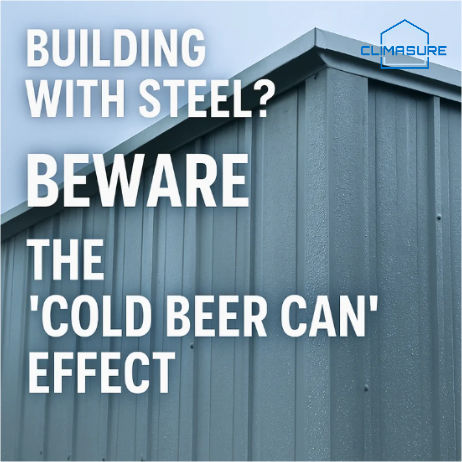
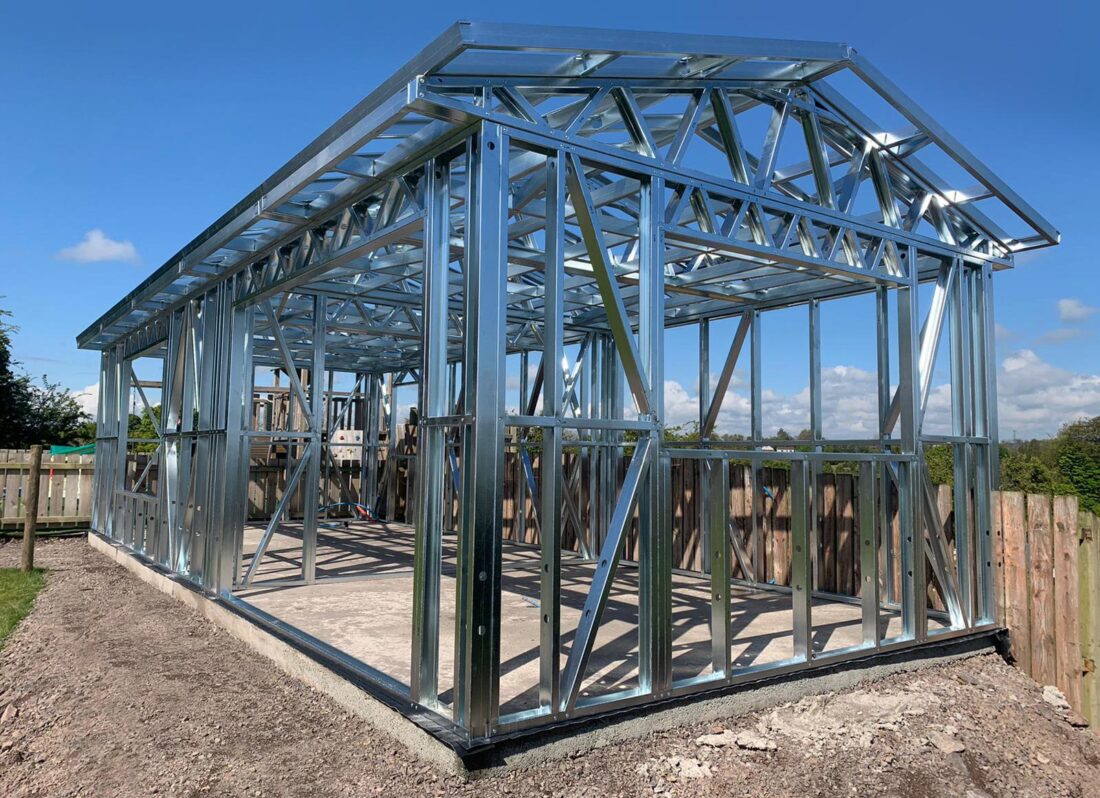
Steel framing is incredibly popular for modern homes. It’s strong, termite-proof, and great for achieving wide, open spans. It’s also very common for the “Shouse” design (shed/house) that is becoming increasingly popular at the moment! But from a building science perspective, steel comes with a significant catch: it is highly thermally conductive.
If you don’t design your insulation and ventilation systems specifically to handle steel’s unique properties, you can quickly find yourself dealing with “unexplainable” moisture, condensation, and recurring mould.
Here is what you need to know about the science of building with steel, and how to avoid the most common pitfalls.
The Problem: Thermal Bridging and the “Cold Beer Can”
When the temperature drops overnight, steel gets very cold, very fast. If your house is warm inside, and you are cooking/showering/breathing/washing/watering plants, this warm air with increased humidity will likely find its way into your roof cavity or wall spaces through gaps and penetrations in the plasterboard layer.
When warm, humid air hits cold steel, you get condensation. It is the exact same physics as taking a cold can of beer out of the fridge on a warm day – water beads form on the surface. In a house, that condensation then drips onto your plasterboard or other water sensitive materials around it. Mould thrives in damp conditions and only needs 48 hours to start to germinate, so if this condensation cycle occurs nightly throughout winter, you are potentially creating the perfect environment for mould to grow in your wall or roof cavity where it could remain undetected for a very long time.
Condensation and mould are the most dangerous side effects of cold steel, but heat loss and gain is another feature of steel framing. Because steel conducts temperature so well, it creates a “thermal bridge” which is a technical term for a direct pathway for outside temperatures to bypass your insulation and travel straight into, or out of, your home. This is yet another way your home makes your air conditioning systems have to work that bit harder to keep temperatures constant and comfortable.
The Pitfalls of Traditional Insulation
When trying to stop this condensation, many builders and homeowners rely on traditional insulation methods that simply don’t work for steel:
Depending on the type of steel and insulation, steel is more than 1,000 times more thermally conductive than a standard insulation batt (source: https://uchi.vscht.cz/e-tables/conductivity-solids?jazyk=en&lang=en).
When calculated as an overall wall assembly, US test data shows that standard steel framing can reduce the nominal R-value of cavity insulation by 40% to 65% (source: https://masonryadvisorycouncil.org/wp-content/uploads/2023/10/Steel-Stud-Wall-Systems-R-Value.pdf).
In some cases, if moisture gets trapped above the plasterboard, those thick batts might actually slow down the cavity’s ability to dry out.
Squashed Roof Blankets: A common practice is rolling an insulation blanket under the metal roof sheets. The purpose of this blanket is to keep the roof sheets warm with the use of the bulk insulation so that condensation does not form.
However, where the blanket is squashed down tightly against the steel rafters, it loses its loft (the trapped air that actually provides the insulation). At the exact point where you need thermal protection the most, the squashed blanket provides almost none.
These blankets can also sag over time and lose contact with the roof sheet, which means it is no longer keeping that roof sheet warm and condensation can form and get trapped between the roof sheet and the foil backing on the blanket, wetting the blanket and turning it to mush over time.
The Ventilation Trap
A common knee-jerk reaction to a stuffy or damp roof cavity is to cut in eaves vents or install whirlybirds. But a house works as a system, and adding ventilation blindly can sometimes make the problem worse.
Depending on your climate, by adding vents, you might accidentally introduce more moisture-laden air from outside. Furthermore, low-pitch roofs require significant airflow to ventilate properly; you might be letting outside air in without extracting it fast enough to keep the space dry.
It is important to work out where the moisture is coming from before you create a solution. Is it coming from outside? Or is it coming from inside your house leaking up through your light penetrations and being dumped into the roof space via your exhaust fans?
Our Advice: Instead of guessing what the best solution might be, use data. Place a temperature and humidity data logger in the roof space to track temperature and relative humidity (for example, a SwitchBot Indoor/Outdoor Thermo-Hygrometer over winter, or a HOBO MX2301A for year-round use). If humidity is consistently sitting at 70–80%, then you can use that information to further assess whether you need to introduce drier outside air or focus on stopping indoor air from escaping into the cavity.
The Solution: Keep the Steel Warm
Air and moisture are notoriously difficult to control, especially if you are trying to retrofit a solution to an existing building. The most fool proof way to prevent thermal bridging in a steel-framed building is to insulate the steel externally.
Going back to our beer analogy: warm beer cans don’t get condensation on them.
To keep the steel warm, you need external, continuous, rigid insulation. This breaks the thermal bridge, preventing the cold outside air from ever reaching the steel structure, which stops the condensation cycle in its tracks.
The National Construction Code (NCC) already requires a thermal break (a strip or layer of material rated at least R0.2) between the steel frame and the cladding or roof sheets in many steel-framed homes. This helps, but R0.2 is a minimum and it is very small. Continuous external insulation does far more to keep the steel warm.
At the moment we are loving Basroc 50mm or 100mm rigid insulation. This cladding product can be used as a render substrate or you can fix lightweight cladding to battens. See the website for more information.
The same rule applies to the roof. A continuous layer of rigid insulation above the steel rafters or purlins, under the roof sheets, keeps the roof steel on the warm side. Roof sheets must then be fixed through the insulation with the correct battens and screws, so talk to us about the right system for your roof.
Important: Keeping the steel warm fixes the cold surface, but you also need to stop moist indoor air getting into the cavity. An airtight membrane on the ceiling, taped at every join and sealed around downlights, exhaust fans and other penetrations, stops warm, humid air from leaking into the roof space. Also make sure your exhaust fans are ducted to the outside, not into the roof space.
What if the mould is already there?
If a thermal bridge has already caused mould to grow on your plasterboard or other moisture sensitive materials, you cannot simply paint over it or clean it with bleach. Plasterboard is highly porous, and mould grows deep roots (hyphae). Treating the surface only temporarily resolves the issue; the mould will return the next time the weather creates the right conditions.
To truly fix the problem, you must address the root cause of the thermal bridging, replace the affected porous materials entirely, and ensure the remediation is done carefully to prevent spores from spreading to your furniture.
If you are planning a steel-framed build or are currently battling condensation issues, getting the building science right is critical.
Reach out to the Climasure team today to ensure your home’s system is designed to stay warm, dry, and healthy.