View Cart
Sub-Total: $0.00

What is K-Value?
So last time we looked at R-Value v U-Value. Today we’re talking about K-Value.
But before we get into that, a quick refresher:
R value = how well a material resists the flow of heat and it is dependent on the thickness of the material.
U value = measures how much heat is actually lost through a building assembly (like a window or a door).
So… what is K-value?
K-Value is how easily heat travels through a single material, regardless of thickness. It’s a property of the material itself.
So now we’re primed to talk about timber v steel wall framing
Steel vs. Timber
This discussion gets people all riled up – there’s pros and cons to both options – but I am not here to get deep into that, I am just here to focus on the science behind how they perform thermally.
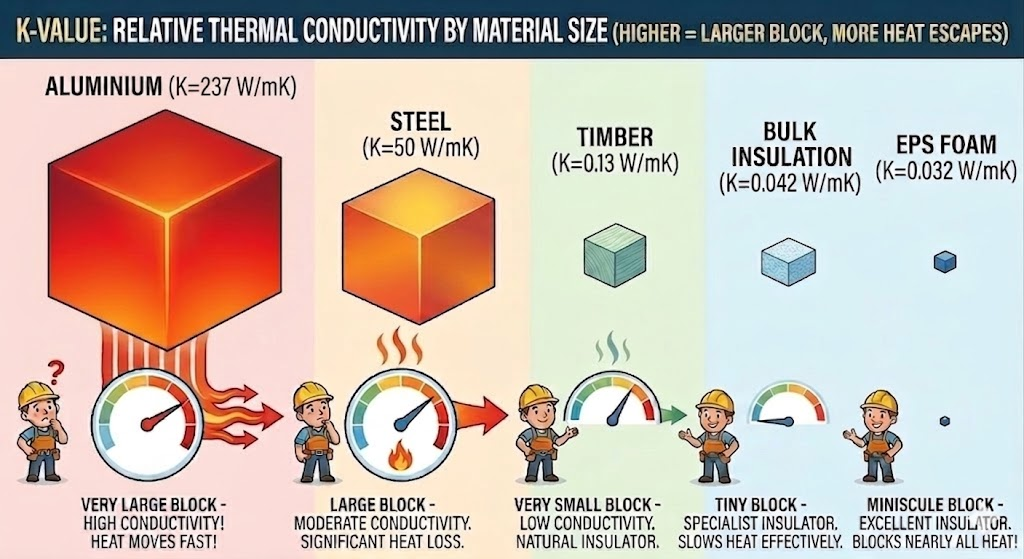
To give you some context on the thermal performance of various building materials, below is an image comparing the conductivity of different materials that are used in building a wall.
Let’s start at the best insulator.
EPS foam 0.032w/mk
EPS is a very good insulator. It has one of the lowest k values of all the materials we use in building a house and that’s why it’s a popular product to insulate under slabs (it burns very quickly though and is full of toxic chemicals… so this is important to factor in your material choices). There are other high density rigid insulation products, such as stone wool, that may be better for your project. This is just one example of a common building material)
Bulk insulation – 0.042 w/mk
That’s the standard insulation batts you put in your wall. They work well too if they’re installed without gaps and bunching
Timber – 0.13 w/mk
Timber is our standard framing material. Interestingly, it is 3 x more thermally conductive than insulation and so is considered a “thermal bridge” as heat and cool moves more quickly through timber than it does through the insulation, particularly when there is large, uninsulated bunch of timber like at corner junctions
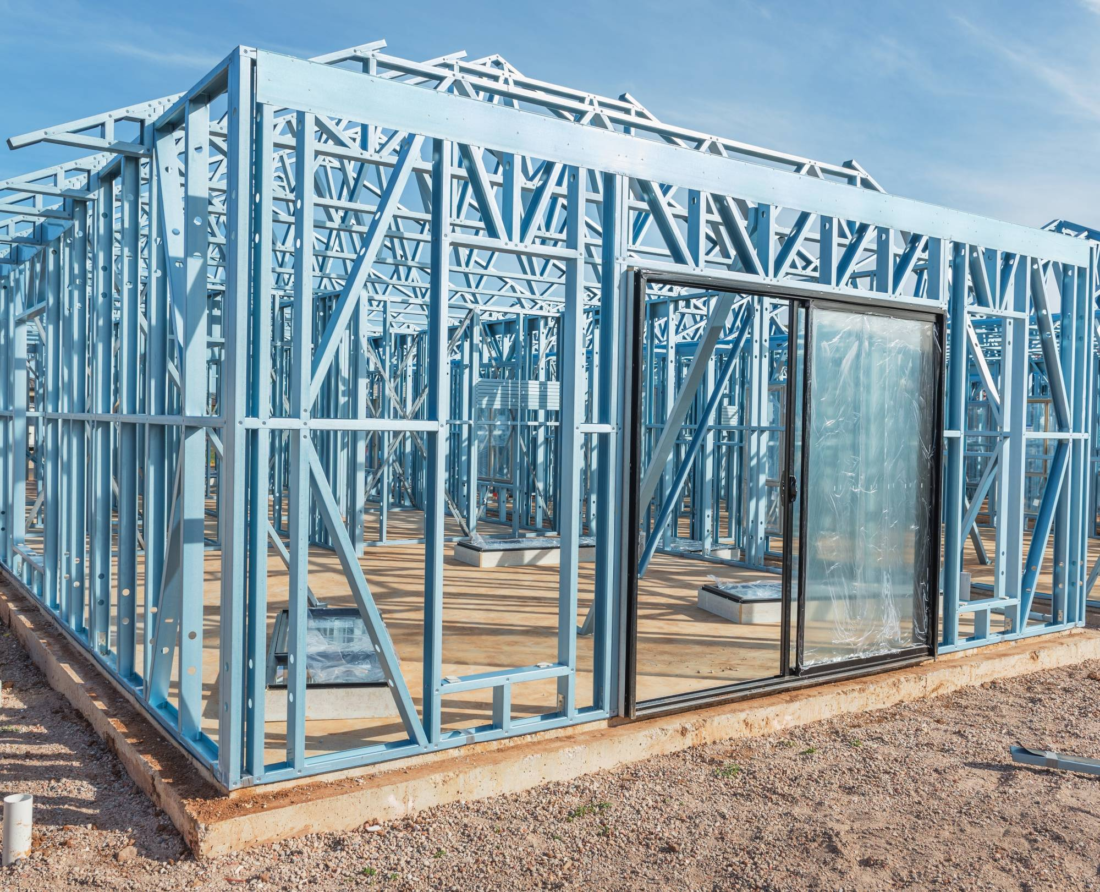
Steel – 50w/mk
Here’s the kicker. Steel is 384 x more thermally conductive than timber.
So by putting steel in your walls, you are transferring heat out of your building a lot faster. You are effectively reducing the R value of your insulation by 40% – 50% because the heat just races right past it.
I did some calculations, and I won’t bore you with the details, but in order to make a steel framed wall that performs as well as a timber framed wall (or has the equivalent U value) you would need to add 15mm of continuous EPS insulation to the outside of the wall.
Additional note: That continuous 15mm EPS layer has a R value of approximately R0.47 – the minimum NCC thermal break requirement is R0.2 strips on the steel (not a continuous layer). This is a minimum safety measure to prevent condensation, they don’t get anywhere near making up for the thermal conductivity of the steel framing.
Interesting huh?
Aluminium – Up to 237w/mk
Then we go to aluminium which is what a lot of our windows frames are made from…
Aluminium is up to 5.7x more thermally conductive than steel (or 1,823x more thermally conductive than timber)
So if you put a steel frame + aluminium windows in a wall – the overall U value of that wall system is going to be much higher (read, the thermal performance will be much lower) than a timber framed wall + thermally broken aluminium frames or uPVC frames.
Thinks systems.
I’m nearly done, but we can’t talk about steel or aluminium without talking about dew point. Especially as we’re coming into winter again. This is not a dew point article – so I will keep it brief.
Cold surfaces in cold climates where there is warm, humid air inside (where people are heating, breathing, cooking, washing etc) increases condensation risk on those cold surfaces. If it’s cold outside, and warm inside, you could be creating a dew point temperature on your steel frames inside your wall or roof, where your water vapour becomes water and you over time you have a mouldy mess where you can’t see it.
Buildings don’t like baths. Make sure your water vapour doesn’t turn into water by keeping surface temperatures warm!
Think about the properties of your materials when you are designing!
Cheers!